
Every pedestrian hit by a car in Los Angeles faces a critical question: Will insurance limits be enough to cover all losses? Minimum policy amounts can still fall short, leaving injured people at risk for unpaid medical bills, lost wages, and ongoing care.
The true impact of these limits becomes clear only after an accident, especially when costs quickly exceed what a driver’s insurance policy covers. Knowing how California insurance rules work, what additional policies may provide, and which legal options remain is key for anyone seeking fair compensation after a crash.
Understanding California’s Minimum Liability Coverage for Pedestrian Accidents
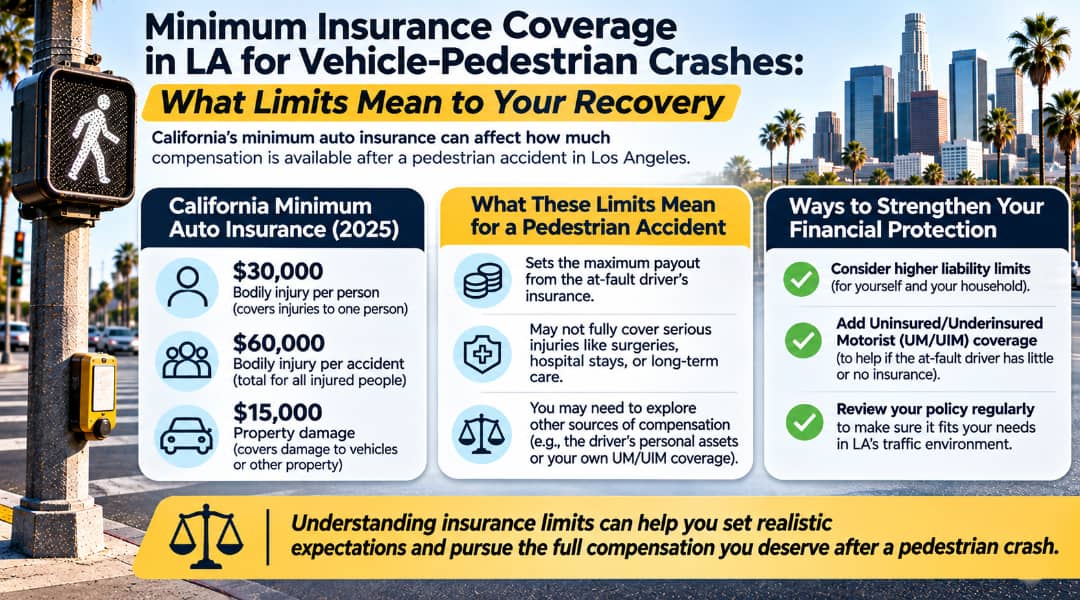
California law increased the minimum liability coverage requirements for standard auto insurance policies beginning January 1, 2025. The current minimums are $30,000 for injury or death to one person, $60,000 for injury or death to more than one person in a single accident, and $15,000 for property damage. These requirements are established under California’s financial responsibility laws. These limits mean that, after a pedestrian accident, an injured person generally can claim up to $30,000 from the at-fault driver’s bodily injury liability coverage for their injuries, subject to the $60,000 total limit when multiple people are injured. The amount available may not be enough when injuries are severe or require long-term treatment, which is a common concern for those hurt in vehicle-pedestrian crashes.
Is there more protection if the driver has extra coverage? Yes, but not every driver carries liability limits above the state minimum. This is why reviewing all possible insurance sources is crucial. The choices made at this stage can shape the outcome of a claim.
For anyone seeking answers, speaking with a Pedestrian accident lawyer in Los Angeles at Venerable Injury Law can help clarify what coverage may apply and what steps can protect their legal rights.
We will work tirelessly to help you recover the compensation you need to move forward with your life

Why Low Policy Limits Often Leave Pedestrian Victims Undercompensated
Many people wonder why minimum insurance coverage often does not meet the needs of injured pedestrians after a crash.
Medical costs from a serious pedestrian accident can quickly exceed the minimum insurance payout. Hospital stays, surgeries, and ongoing rehabilitation add up. The policy limit may be reached before treatment and recovery are complete.
Lost wages and long-term effects make things worse for injured pedestrians. If a person cannot work or needs assistance with daily tasks, the actual financial impact can be much higher than what the insurance covers. The result is a financial gap that the injured person may still face.
There is also no additional payment from the at-fault driver’s liability insurer beyond the applicable policy limit simply because the injured person experiences pain, suffering, or emotional harm. Even when recovery is slow and daily life changes significantly, the insurance company generally remains subject to the policy’s coverage limits. This can leave injured people facing substantial financial and personal challenges.
We will treat you with the respect and compassion you deserve.
How Uninsured and Underinsured Motorist Coverage Can Help Bridge the Gap
Uninsured and underinsured motorist coverage may provide another source of recovery when the at-fault driver’s insurance is unavailable or insufficient.
This additional coverage may apply if the driver who caused the crash has no insurance or carries liability limits that are insufficient to cover the injured person’s damages. It can help pay for qualifying bodily injury losses, subject to the coverage terms and applicable legal requirements.
A policyholder’s own uninsured motorist protection may also apply if the driver flees the scene and cannot be identified, provided the accident and claim satisfy California’s requirements for an uninsured motorist claim. This can allow an injured pedestrian to pursue compensation even when the responsible driver is not found.
Depending on the policy, household members may qualify as insured individuals even when they are not occupying a covered vehicle at the time of the accident. However, coverage depends on the policy language, the person’s insured status, and the circumstances of the collision.
Reviewing existing auto policies for this kind of protection is an important step. It can make a difference when the at-fault driver’s insurance payout is not enough to address the injured person’s covered losses.
Stacking Insurance Policies: Strategies for Maximizing Your Recovery
Stacking insurance policies may seem like a way to increase recovery after a pedestrian crash in Los Angeles. When minimum liability limits leave a shortfall, injured people may look to multiple policies for additional coverage. However, California law places restrictions on combining certain insurance limits.
The state requires standard auto insurance policies to meet minimum liability limits of $30,000 per person and $60,000 per accident for bodily injury. These amounts may still be insufficient for major injuries.
California DMV+1
Optional coverages, such as uninsured or underinsured motorist protection, may provide additional avenues for recovery. However, California Insurance Code Section 11580.2(q) generally prohibits adding together or stacking the limits of multiple uninsured motorist coverages to increase the available amount.
Justia Law
This restriction does not mean that only one insurance policy can ever be relevant to a pedestrian accident claim. Different policies may provide separate coverage depending on the responsible parties, the type of insurance, and the circumstances of the accident. Each policy must be reviewed to determine whether coverage applies and whether any exclusions or limitations affect the claim.
This process requires careful examination of policy language and, in some cases, legal guidance. For those facing substantial medical bills after a crash, understanding the difference between available coverage and legally restricted stacking can help inform discussions with insurance adjusters and legal counsel.
You are not just a case number – you are our top priority.
Employer and Rideshare Coverage: Additional Avenues After a Crash
After a pedestrian crash in Los Angeles, some claims may reach beyond the driver’s personal insurance limits.
Employer liability: If the driver was working at the time of the crash, the employer’s insurance may provide another source of recovery. This type of claim generally depends on whether the driver was acting within the scope of employment when the accident occurred. The employer’s potential liability must be established based on the specific facts.
Rideshare company coverage: When a rideshare vehicle is involved, additional insurance may apply. Companies such as Uber and Lyft maintain insurance arrangements that can provide coverage depending on whether the driver was waiting for a ride request, traveling to pick up a passenger, or transporting a passenger. The driver’s status at the time of the collision is an important factor in determining which coverage applies.
Other business or commercial coverage: If a delivery vehicle or commercial transport is involved, additional business insurance policies may cover damages. These policies can have different coverage limits and conditions from personal auto insurance, potentially providing another avenue for addressing losses caused by serious injuries.
How Medical Liens and Subrogation Affect Your Net Compensation
Medical liens and subrogation play an important part in determining the actual amount an injured person receives after a pedestrian accident claim is resolved.
Medical liens may allow hospitals, doctors, or other healthcare providers to seek payment from settlement proceeds for treatment provided to the injured person. This means certain outstanding medical expenses may need to be addressed before the injured person receives their remaining settlement funds. If the total recovery is limited by insurance policy limits, there may be less money available after valid liens are resolved.
Subrogation allows certain health insurers to seek reimbursement for medical expenses they paid when another party was responsible for the injury. Insurers may assert repayment rights against settlement proceeds, which can further reduce the final amount received by the injured person. The process can be complex, and the amount owed depends on the applicable health plan, governing law, and circumstances of the claim.
There is a real risk that, even after a claim is settled, net compensation may be much less than expected once valid liens and subrogation claims are addressed. This makes it important to understand how these repayment rights work, especially in cases where insurance limits are low or medical costs are high.
What Happens When Your Injuries Exceed Policy Limits
Several outcomes may follow when injuries from a pedestrian crash exceed the at-fault driver’s insurance policy limits. California requires drivers to maintain financial responsibility, but the minimum coverage may still fall short when medical bills, lost wages, and other damages are substantial.
For example, if an injured pedestrian has $50,000 in covered damages but the at-fault driver’s applicable bodily injury policy limit is $30,000, the liability insurer generally will not be responsible for paying the additional $20,000 under that policy. Other sources of recovery may need to be explored before determining whether the remaining damages can be recovered.
There are a few paths to address this gap. Claims may be filed under an applicable uninsured or underinsured motorist policy, or another responsible party’s insurance coverage could be explored. California also follows comparative negligence principles, meaning an injured pedestrian’s percentage of fault can reduce the damages recoverable from other responsible parties.
The process often involves careful review of all available insurance policies and clear medical documentation to support the claim’s value. When policy limits are reached, further negotiations or legal action may be necessary to pursue additional compensation from other potentially responsible parties.
The practical effect is that reaching a policy limit does not always mean an injured person has recovered the full value of their losses. Understanding every available insurance option and identifying all potentially liable parties can help determine what compensation may remain available.
Deciding if minimum insurance will cover a pedestrian’s needs after a crash involves several key steps. First, check the at-fault driver’s policy to determine whether it meets California’s current $30,000 per person and $60,000 per accident bodily injury minimums.
Next, review any uninsured or underinsured motorist coverage that might apply. Consider whether other insurance policies from different sources could provide additional coverage, while accounting for California’s restrictions on stacking. Examine whether an employer, rideshare company, or commercial vehicle operator may have potential liability.
We recommend reviewing all available options with a trusted legal advocate, as each step can affect how much compensation may ultimately be recovered.
We believe that our experience, dedication, and personalized approach set us apart from the rest.