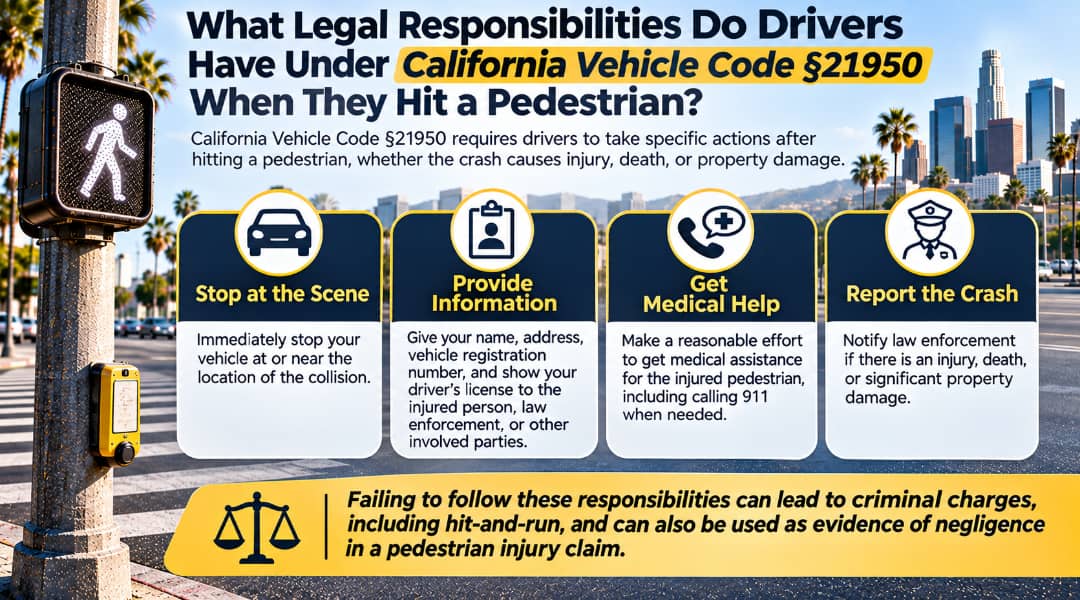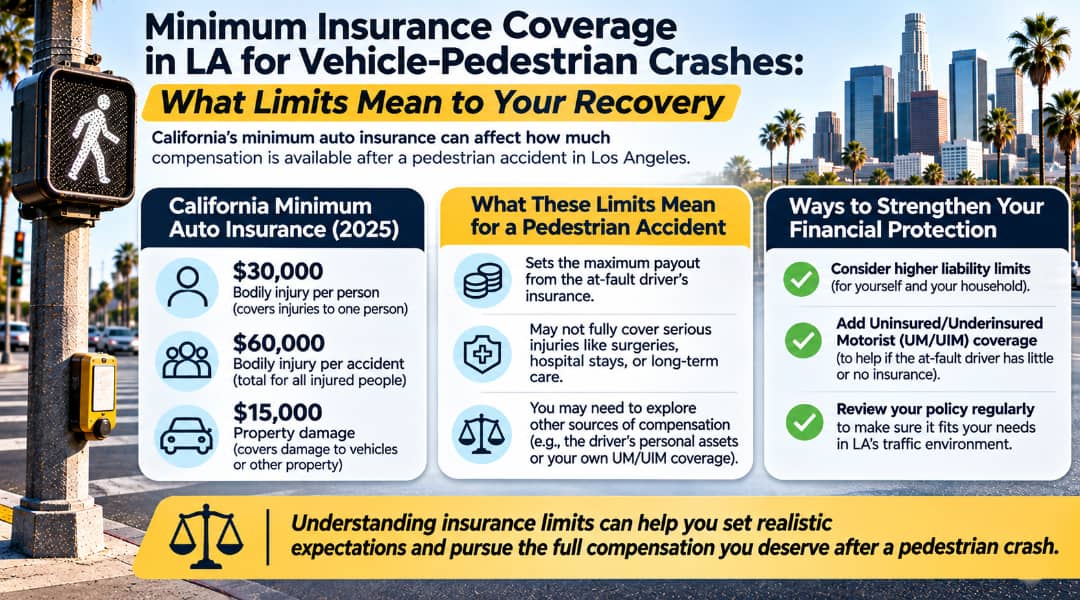

California Vehicle Code §21950 sets clear legal duties for drivers when sharing the road with pedestrians in Los Angeles. This law goes beyond simple courtesy: it defines when a driver must yield and what responsibilities apply when a pedestrian is struck.
Drivers who violate these rules may face legal consequences under negligence per se, a principle that can create a presumption of negligence when specific legal requirements are met. Understanding these responsibilities and the ways evidence is used to establish a violation is central to holding drivers accountable and supporting fair outcomes for those harmed in pedestrian accidents.
Understanding California Vehicle Code §21950: Driver Duties to Pedestrians
Several critical rules shape the duties of drivers under California Vehicle Code §21950 and related laws. For anyone seeking a Pedestrian accident lawyer in Los Angeles, understanding these responsibilities is important when evaluating whether a driver met their legal obligations or breached them at the time of the incident.
The law requires drivers to yield the right-of-way to pedestrians crossing the roadway within marked crosswalks or unmarked crosswalks at intersections, subject to applicable statutory exceptions. This protection applies even when an intersection has no painted crosswalk lines.
Drivers approaching pedestrians within these crosswalks must also exercise due care. They are required to reduce their speed or take other necessary actions to safeguard pedestrian safety.
Pedestrians also have legal responsibilities under §21950. They must use due care for their own safety and cannot suddenly leave a curb or another place of safety and enter the path of a vehicle that is so close as to constitute an immediate hazard. They must also avoid unnecessarily stopping or delaying traffic within a crosswalk.
Failing to meet these responsibilities can affect liability when an accident occurs. These requirements are not just technicalities; they serve as a foundation for evaluating claims after a collision and determining whether a driver’s actions contributed to a pedestrian’s injuries.
We will work tirelessly to help you recover the compensation you need to move forward with your life

What Constitutes a Violation of §21950 at Los Angeles Crosswalks
Violating California Vehicle Code §21950 at Los Angeles crosswalks centers on specific actions or failures by drivers that put pedestrians at risk.
1. Failing to yield to pedestrians while driving through a crosswalk can constitute a violation. When drivers allow distractions, such as texting or adjusting GPS controls, to pull their attention from the road, they may fail to recognize people crossing. This failure to yield, particularly at marked or unmarked crosswalks, can support a finding of negligence when the statutory requirements are satisfied.
2. Driving at a speed that is unsafe for the surrounding conditions, even if under the posted limit, may violate California Vehicle Code §22350, the state’s basic speed law. Heavy foot traffic, low visibility, or poor weather require drivers to adjust their speed and remain alert. If a motorist travels too quickly for these conditions and strikes a pedestrian, the circumstances may support a separate finding of negligence.
3. Using a handheld device or engaging in activities that distract from driving may also contribute to a pedestrian accident. California law restricts handheld wireless telephone use while driving. Distraction can reduce a driver’s reaction time and increase the likelihood of failing to recognize someone crossing. Although distracted driving is not itself a specific violation of §21950, it may provide relevant evidence when evaluating whether the driver exercised the required care. Each of these circumstances can support a pedestrian’s claim if an injury occurs, making it important to identify and document the driver’s specific conduct.
We will treat you with the respect and compassion you deserve.

Negligence Per Se: How Statutory Breach Proves Driver Fault
Negligence per se is a legal principle that can make proving negligence easier in pedestrian accident cases.
1. When a driver violates California Vehicle Code §21950 by failing to yield to a pedestrian in a marked or unmarked crosswalk, that violation may establish a presumption of negligence. Under California Evidence Code §669, four requirements generally apply: the person violated a statute, the violation caused an injury, the injury resulted from the type of occurrence the statute was designed to prevent, and the injured person belonged to the class the statute was intended to protect.
2. If a driver violates this duty and hits a pedestrian, the law may allow the injured person to rely on the statutory violation to establish the applicable standard of care. However, the violation does not automatically establish liability. The injured pedestrian must still establish causation, and the driver may have an opportunity to rebut the presumption through legally recognized evidence.
3. This legal principle means that establishing negligence per se can strengthen a pedestrian’s case when the statutory requirements are satisfied. Identifying and documenting a potential violation of §21950 is therefore important when evaluating the circumstances surrounding an accident.
Types of Evidence Used to Establish Violations in Pedestrian Accidents
Several types of proof can help establish a violation of California Vehicle Code §21950 in pedestrian accident cases. Eyewitness accounts often clarify whether a driver failed to yield at a marked or unmarked crosswalk, which is a key requirement under the law.
Traffic camera footage may show the sequence of events, including whether a pedestrian was crossing within the crosswalk and whether the driver responded appropriately. Physical evidence, such as skid marks or vehicle position, can reveal whether the driver attempted to stop or reacted too late.
Determining fault requires careful analysis of both driver and pedestrian actions, as both have legal responsibilities under §21950. Sometimes, pedestrians may have contributed to the accident by crossing against a signal or entering the roadway when a vehicle was too close to stop safely. These circumstances could affect the allocation of liability.
This means gathering evidence about both parties’ conduct is vital to determining whether the driver’s duty to yield was breached or whether shared fault may apply. Strong, clear evidence can help clarify responsibility and support a fair outcome for injured pedestrians.
You are not just a case number – you are our top priority.

Role of Police Reports and Traffic Cameras in Proving Driver Liability
Police reports and traffic camera footage are two critical tools for clarifying what happened in a pedestrian accident.
1. Police documentation: Officers arriving at the scene will typically prepare a report that records statements, diagrams, and their observations. This report can capture details such as where the collision took place, the parties involved, and whether the driver appeared distracted. Although a police report can provide valuable information, its findings do not automatically determine civil liability.
2. Traffic camera evidence: Video footage from nearby cameras can show the sequence of events leading up to the crash. It may reveal whether the driver failed to yield at a marked or unmarked crosswalk, as required by California Vehicle Code §21950, or whether the pedestrian entered the roadway in a manner that affected the collision.
3. Comparing accounts: When police reports and video evidence are combined, they offer a more complete picture. Conflicting statements can be examined against available footage to resolve disputes about who had the right-of-way and how the accident occurred.
4. Supporting legal claims: Capturing traffic camera footage and preserving police documentation can help establish whether a driver breached their duty under Vehicle Code §21950. Strong evidence can help address disputes about fault and provide support when presenting an injury claim to an insurance company or in court.
Comparative Fault: When Pedestrian Conduct Affects Your Claim
There are several ways a pedestrian’s own actions can affect who is found at fault after a vehicle collision.
1. If a pedestrian crosses at a marked or unmarked crosswalk, drivers are generally required to yield under §21950. However, pedestrians also have responsibilities under California law, including exercising due care and avoiding suddenly entering the path of a vehicle that presents an immediate hazard. Both parties’ actions must be considered when determining liability.
2. Distraction is a common issue for both drivers and pedestrians. Using a mobile phone, headphones, or other electronics can affect awareness and reaction times and may contribute to a finding of shared fault if an accident occurs. The circumstances must be evaluated to determine whether either party failed to exercise reasonable care.
3. Intoxication is another important factor. A pedestrian impaired by alcohol or drugs may be found partly at fault for their own injuries, particularly if their conduct contributed to the collision, such as entering traffic without exercising reasonable care or disregarding applicable signals.
4. Comparative fault rules in California allow injury claims even when a pedestrian shares some responsibility for an accident. The compensation a pedestrian receives may be reduced by their percentage of fault, but recovery is not automatically barred if the driver’s actions also contributed to the accident.
How Courts Assess §21950 Violations and Their Legal Consequences
California courts consider the specific circumstances of pedestrian accidents when evaluating violations of §21950 and their impact on liability. A driver’s failure to yield to a pedestrian in a marked or unmarked crosswalk may support a finding of negligence, depending on the evidence and whether the statutory requirements are satisfied.
Other cases may involve questions about driver distraction, reaction time, and whether a motorist exercised reasonable care when approaching a crosswalk. Courts also consider whether the pedestrian contributed to the accident, for example by crossing against a signal or suddenly entering the roadway when a vehicle was too close to stop safely.
These principles show that courts weigh both the driver’s duty to yield and the pedestrian’s actions at the moment of the incident. The outcome often depends on clear evidence that a driver failed to meet their legal responsibilities, although shared fault and other circumstances may also affect the result.
For anyone affected by a pedestrian accident, understanding how courts interpret §21950 can help clarify what evidence and legal arguments may be relevant when pursuing an injury claim.
Drivers in Los Angeles have a duty under California Vehicle Code §21950 to yield to pedestrians crossing within marked crosswalks or unmarked crosswalks at intersections. They must also exercise due care and take appropriate action to safeguard pedestrian safety.
Failing to yield or approaching a crosswalk without taking the necessary precautions may constitute a violation of this law. When a driver breaches §21950 and strikes a pedestrian, that violation may establish a presumption of negligence under California Evidence Code §669, provided the necessary legal requirements are met.
Strong evidence, such as eyewitness accounts, traffic camera footage, and police reports, is important for showing how the violation occurred. Even if the pedestrian shares some responsibility, California’s comparative fault rules may allow for partial recovery.
This means a pedestrian may still receive compensation, although the amount can be reduced by their percentage of fault. Courts examine the available evidence, the driver’s conduct, and the pedestrian’s actions when determining responsibility, making the specific circumstances of each accident essential to evaluating a claim.
We believe that our experience, dedication, and personalized approach set us apart from the rest.